Marine pilings Gulf Coast: 5 specification mistakes that inflate your project cost

Marine pilings Gulf Coast contractors order with the wrong AWPA Use Category, preservative system, or lumber grade cost thousands of dollars in reorders, project delays, and early replacement. Every saltwater project on the Texas and Louisiana coast falls under UC5C, the highest marine hazard zone in the continental US, and the specification mistakes we see most often come from experienced contractors who know the work but miss the details that drive cost.
This is not a beginner’s guide. If you have been driving pilings on the Gulf Coast for years, you already know the basics. What follows are 5 specific specification mistakes that inflate project cost on marine pilings Gulf Coast jobs require, and what the correct spec looks like for each one.
Specification summary
- Mistake 1: Wrong coastal zone classification. Specifying UC5B retention in UC5C water under-protects the piling and builds in early failure.
- Mistake 2: Skipping Marine and Seawall grades. Standard grades leave untreated heartwood pathways that marine borers exploit.
- Mistake 3: Oversizing instead of dual-treating. A bigger pile costs more to buy, ship, and drive than a standard-diameter dual-treated pile.
- Mistake 4: Ordering without exact retention specs. A piling delivery with the wrong Use Category creates an immediate project delay.
- Mistake 5: Skipping pre-treatment fabrication. Every field cut on a marine piling requires M4-compliant treatment. Fabricate before treating to eliminate that labor.
Mistake 1: Specifying the wrong coastal zone for marine pilings Gulf Coast projects need
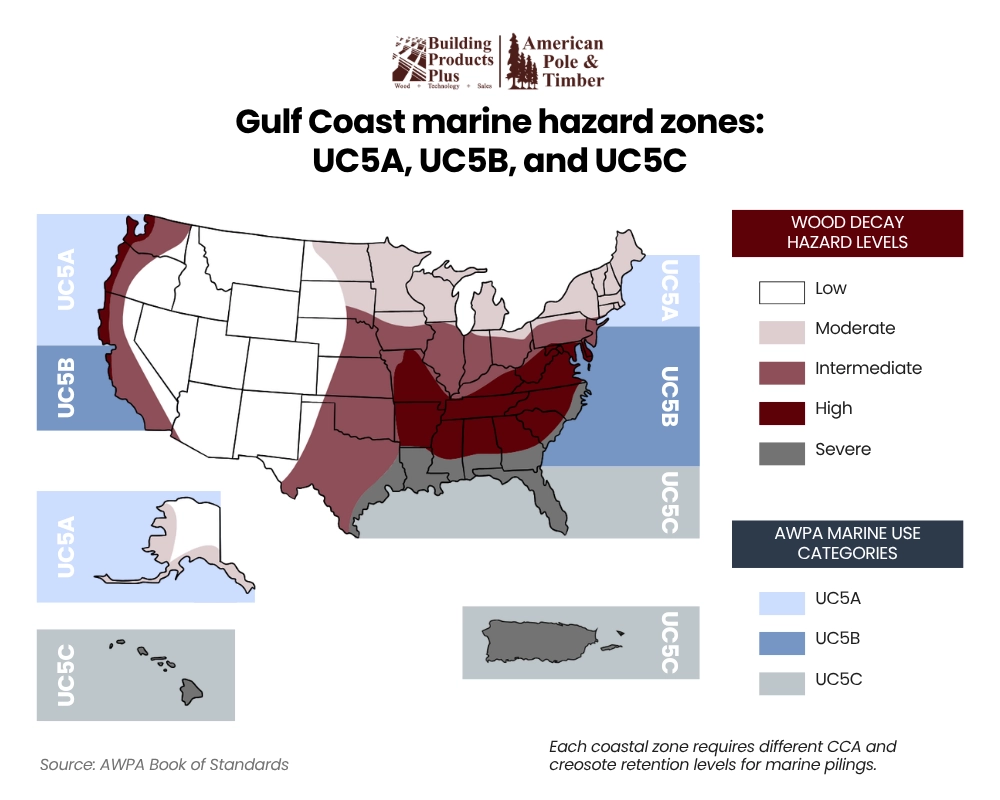
The AWPA Standard U1 divides the US coastline into three marine Use Categories. UC5A covers northern waters (Long Island north, San Francisco north). UC5B covers central waters (Long Island south to the Georgia border). UC5C covers everything south of Georgia, the entire Gulf Coast, Hawaii, and Puerto Rico.
For contractors working out of Houston, Galveston, Freeport, Port Arthur, Lake Charles, or anywhere on the Texas and Louisiana coast, the classification is always UC5C. We see contractors spec UC5B retention on marine pilings Gulf Coast projects require UC5C for. The retention gap between the two zones is the gap between a piling that lasts decades and one that fails in years.
Understanding which marine wood destroying organisms are active in Gulf Coast waters explains why the retention jump between UC5B and UC5C is so significant.
Here is how retention requirements compare across zones:
| Coastal zone | UC | CCA single (pcf) | Creosote (pcf) | Dual treatment |
|---|---|---|---|---|
| Northern (NY north, SF north) | UC5A | 1.5 / 0.9 | 16 | n/a |
| Central (NY to GA border) | UC5B | 2.5 / 1.5 | 20 | n/a |
| TX, LA, Gulf Coast | UC5C | 2.5 / 1.5 | 20 | CCA 1.0 + CR 20 |
Mistake 2: Skipping Marine and Seawall grades on saltwater pilings
The Southern Pine Inspection Bureau (SPIB) grading rules include two categories specifically for marine lumber. Marine grade requires all four longitudinal faces to be free of pith and heartwood, ensuring the sapwood zone (which accepts the full preservative charge) is exposed on every face.
Seawall grade requires one wide face and both narrow faces clear of pith and heartwood. It is intended for bulkhead sheeting and should be stamped THIS SIDE SEAWARD. The marginal cost increase per board foot is small. The alternative is untreated heartwood pathways that marine borers use to reach the interior of the timber. We see standard grades specified on marine pilings Gulf Coast bulkhead projects demand Marine or Seawall grade for, and the resulting borer damage shows up within a few years.
Mistake 3: Oversizing single-treatment piles instead of dual-treating
In UC5C waters, dual treatment is the standard for maximum protection. The first cycle applies CCA at 1.0 pcf. The second applies creosote at 20 pcf. This combination provides both the leach-resistant copper-arsenate barrier and the oil-based physical barrier of creosote.
Some contractors try to compensate for single treatment in UC5C by ordering larger diameter piles. The logic is that a bigger pile provides a thicker sacrificial shell. In practice, that approach increases pile cost, driving cost, and handling difficulty. In our experience supplying marine pilings Gulf Coast contractors rely on, dual treatment on a standard-diameter pile typically costs less and provides better long-term protection than an oversized single-treatment alternative.
Mistake 4: Ordering marine pilings Gulf Coast projects need without verifying retention
A piling delivery with the wrong Use Category or retention level creates an immediate project delay. The pilings either go back or become a liability. The cost of reordering, reshipping, and lost crew time typically exceeds the price difference between the correct and incorrect spec.
When ordering treated pilings for saltwater work, specify the exact AWPA Use Category (UC5C for all Gulf Coast projects), the preservative system (CCA, creosote, or dual), and the retention level in pcf. Verify quality marks on delivery before unloading.
For projects where treated timber is not the right fit, Building Products Plus also supplies EcoPile® vinyl composite pilings and XPile™ FRP marine piles. EcoPile® is a PVC/fiberglass composite with a 25-year limited warranty. XPile™ is a fiber reinforced polymer pile that is corrosion-free and resistant to marine borers. Both are worth evaluating when the project calls for something other than treated timber.
Mistake 5: Skipping pre-treatment fabrication and paying for field treatment labor
AWPA Standard M4 requires field treatment of all cuts and holes that penetrate the treated zone. On a marine piling project, every bolt hole, notch, and cut end needs copper naphthenate at minimum 2% copper metal. Exposed pile tops should be capped.
The most cost-effective approach is to complete all boring, notching, and cutting before the pilings enter the treating cylinder. This eliminates field treatment labor entirely at those connection points. Where field fabrication is unavoidable, budget the labor and materials for M4 compliance into the estimate from day one. Skipping this step is not a savings. It is a warranty exposure.

Why is demand for marine pilings Gulf Coast growing in 2026?
Marine construction activity along the Texas and Louisiana coast is expanding. New shipyard facilities near the Houston Ship Channel are coming online, including a 660-ton Marine Travelift operation on Dickinson Bayou scheduled for full commercial service in 2026. Several Gulf Coast shipyards are investing in expanded capacity.
At the federal level, America’s Maritime Action Plan was released in February 2026 as a comprehensive blueprint to rebuild US shipbuilding capacity and strengthen port infrastructure. WorkBoat’s coverage of the Maritime Action Plan outlines the scope of the planned investment. For marine contractors in Texas and Louisiana, more infrastructure means more piling projects, and getting the spec right on every order protects your margin.
Where do Texas and Louisiana contractors source marine pilings Gulf Coast projects require?
Building Products Plus supplies round timber pilings, sawn marine lumber, and complete dock material packages from our facility in Houston, TX. We serve marine contractors from Galveston and Freeport to Port Arthur, Lake Charles, and the Sabine Pass. Our team can match piling diameter, length, preservative system, and retention to your project. Whether you need CCA-treated round pilings for a residential dock, dual-treated pilings for a commercial marina, or Seawall-grade sheeting for a bulkhead, we deliver the correct specification to your job site.
Frequently asked questions about marine pilings Gulf Coast
What AWPA Use Category applies to marine pilings in Texas and Louisiana?
All Texas and Louisiana coastal waters fall under UC5C, the highest marine hazard zone in the continental US. CCA retention is 2.5 pcf for single treatment, or dual treatment uses CCA at 1.0 pcf followed by creosote at 20 pcf.
What is the difference between Marine and Seawall grade lumber?
Marine grade requires all four faces free of pith and heartwood. Seawall grade requires one wide face and both narrow faces clear, intended for bulkhead sheeting. Seawall boards should be stamped THIS SIDE SEAWARD.
Can copper azole or ACQ treated pilings be used in saltwater?
No. CA and ACQ are approved for freshwater and above-ground applications. Marine pilings in saltwater (UC5A, UC5B, UC5C) require CCA or creosote treatment.
What is dual treatment for marine pilings?
Two separate pressure treatments applied in sequence. CCA at 1.0 pcf first, then creosote at 20 pcf. This provides both waterborne and oilborne protection and is the standard for UC5C pilings.
Does Building Products Plus deliver marine pilings to job sites?
Yes. We deliver treated round pilings, sawn marine lumber, bulkhead sheeting, and complete dock packages to job sites across Texas and Louisiana from our Houston facility. Call (713) 434-8008 for availability and lead times.
Sources
- American Wood Protection Association (AWPA), Book of Standards, Standard U1, Commodity Specification E and G
- Southern Forest Products Association (SFPA), Pressure-Treated Southern Pine, Publication #300
- Treated Wood Council, Life Cycle Assessment: Treated Wood Marine Piling
- WorkBoat, “White House releases Maritime Action Plan to rebuild US shipbuilding” (February 2026)
Need help getting the spec right on your next marine piling order? Call our Gulf Coast team at (713) 434-8008 or contact us online.