
Gulf Coast dock construction: 7 steps to save money, cut rework, and build a dock that lasts
Dock construction Gulf Coast projects require early planning around permits, piling materials, storm-resistant design, and contractor selection. These decisions determine what your structure costs to build and how long it holds up in Texas and Louisiana saltwater. Building Products Plus supplies extended-life marine construction materials for Gulf Coast dock construction projects, including treated wood pilings, EcoPile® vinyl pilings, XPile™ FRP pilings, and Gun Barrel Pilings®.
NOAA’s August 2026 hurricane outlook predicts a below-normal season due to a strengthening El Niño, but that forecast comes with a footnote. Tropical Storm Arthur formed in the Gulf in mid-June, brought record rainfall to Louisiana, and spawned tornadoes along the coast. Tropical Storm Bertha followed in July, making landfall in St. Bernard Parish. A below-normal season still produced two named storms before August. The dock construction Gulf Coast projects that hold up are the ones where somebody made the right material and design decisions before the first piling went in the ground.
Below are the 7 steps we walk through with Texas and Louisiana customers before starting dock construction Gulf Coast projects.
Key takeaways
- Flood zone and permit requirements come first. FEMA designations, Texas General Land Office rules, and Louisiana Coastal Use Permits all dictate what you can build.
- Piling material selection is the decision that affects your dock for the next 15 to 50 years. Treated wood, EcoPile® vinyl, XPile™ FRP, and Gun Barrel Pilings® each serve different budgets and lifespans.
- Storm-resistant design is not optional on the Gulf Coast, even in a below-normal hurricane season. Piling size, embedment depth, connection hardware, and framing should be engineered for wind and surge from day one.
- Framing, decking, and hardware take a beating in saltwater too. Specify the right AWPA use category and use galvanized or stainless steel fasteners throughout.
- Budget and timeline should be locked down before you pull the permit. Material costs shift, and permit timelines vary widely between Texas counties and Louisiana parishes.
- Choosing the right marine contractor matters more in saltwater than freshwater. Ask for Gulf Coast references, not lake dock photos.
1. Have you checked your flood zone and local permit requirements?
Flood zone classification and permitting should be the first conversation on any Gulf Coast dock construction project. In Texas and Louisiana, most waterfront properties sit within a FEMA-designated flood zone (usually VE or AE), and that classification controls what you are allowed to build, how deep your pilings must go, and what freeboard the structure needs.
In a VE zone (coastal high hazard), FEMA requires structures to be elevated above the base flood elevation with pilings that can handle wave action, storm surge, and scour. AE zones carry different requirements but still regulate construction near water. Your county or parish building department will have the specific standards.
Texas adds another layer. The General Land Office oversees construction on state-owned submerged land, which includes most of the Texas coast. You may also need permits from the U.S. Army Corps of Engineers (Section 10 for navigable waterways, Section 404 for wetlands) and your state environmental agency.
In Louisiana, the Office of Coastal Management issues Coastal Use Permits for dock construction in the coastal zone. The process can take 30 to 90 days depending on the parish and the scope of work.
A marine contractor who works in your specific area will know which permits apply and how long they take. If your contractor has not brought up permitting in the first conversation, ask. Getting this wrong can shut down a dock construction Gulf Coast project after you have already spent money on materials.
2. What piling material is right for your dock construction Gulf Coast project?
This is the decision that affects your dock for the next 15 to 50 years. Pilings are the foundation. Everything else sits on top of them. If the pilings fail early, you are replacing the entire structure, not just swapping a board.
On the Texas and Louisiana Gulf Coast, your pilings are going into saltwater or brackish water in the UC5C exposure zone, the most aggressive marine environment in the AWPA use category system. Marine borers (shipworms and Limnoria), salt, UV, and warm water temperatures all work against piling materials year-round.
Here is how the options break down.
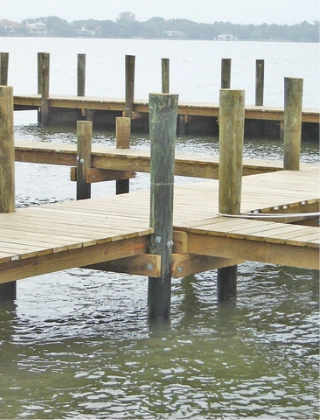
Treated wood pilings
Treated wood pilings are the traditional choice across the Gulf Coast. CCA-treated Southern Yellow Pine at UC5C retention levels (2.5 pcf) delivers proven performance at a competitive price. Expect 15 to 25 years of service depending on borer pressure at your specific location. Every marine contractor from Galveston to Cameron Parish knows how to drive them. In high-borer areas, adding PolyShield polymer coating wraps the piling in a barrier that keeps organisms off the wood and extends its working life.

EcoPile® vinyl composite pilings
EcoPile® vinyl composite pilings eliminate the borer problem entirely. No cellulose, no food source, no rot, no checking. They carry a 25-year warranty and need zero maintenance after they go in the ground. Building Products Plus is the Master Distributor for Shoreline Plastics in Texas and West Louisiana, which means we stock EcoPile® and can get it to your site faster than anyone else in the region. EcoPile® pilings proved themselves during Hurricane Sally in 2020. Marinas on EcoPile® pilings came through with minimal damage while wood and fiberglass docks nearby were wrecked.
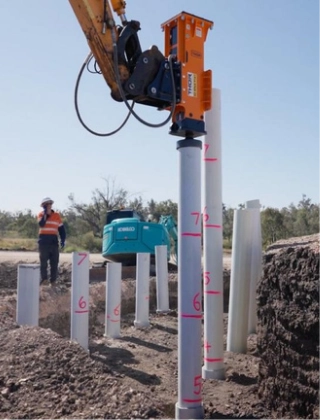
XPile™ FRP pilings
XPile™ FRP pilings are the longest-lived option we carry. Built from pultruded composite fibre technology with an integrated HDPE sleeve, a 12-inch XPile™ weighs just 16.6 pounds per foot and delivers twice the strength of steel by weight. No rot, no rust, no electrolysis, no marine borer damage. Fifty-year design life. For commercial marinas, public piers, LNG facility docks, or industrial waterfront structures along the Houston Ship Channel or Louisiana coast, XPile™ is the top of the lineup.

Gun Barrel Pilings®
Gun Barrel Pilings® are uniform-diameter structural wood pilings manufactured by our sister company, American Pole and Timber, right here in Houston. Same diameter end to end, dead straight, no taper, no sweep, no crook. If your dock construction design leaves the pilings visible (and on the Gulf Coast, most do), Gun Barrel Pilings® give you alignment and appearance that natural peeled poles or square timbers cannot match.
3. What about the framing and decking on top?
Pilings get most of the attention, but the framing and decking take a beating too. Saltwater splash, humidity, UV, and foot traffic all wear on the material above the waterline.
Treated lumber is a common product for dock framing: joists, beams, stringers, and caps. For Gulf Coast saltwater exposure, specify lumber treated to at least UC4A (Ground Contact, General Use) or UC4B (Ground Contact, Heavy Duty) depending on how close the framing sits to the water. Deck boards can be treated wood or composite, depending on the owner’s preference for maintenance and appearance.
For dock owners who want a maintenance-free decking surface, Sure-Step decking is worth looking at. Sure-Step panels are made from 100 percent virgin polypropylene, slip-resistant, barefoot-friendly, and UV-protected. The open chevron pattern lets water and sunlight pass through, which helps the ecosystem underneath the dock. The panels interlock and install without special tools. Four colors, limited lifetime warranty, made in the USA.
Make sure your contractor is using hot-dipped galvanized or stainless steel hardware for all connections. Standard zinc-plated fasteners corrode fast in saltwater air. This is a detail that costs very little upfront and prevents expensive problems later.
4. Is your dock construction Gulf Coast project designed to handle storms?
NOAA’s August 2026 outlook predicts a below-normal hurricane season, but Tropical Storm Arthur already brought record rainfall to Louisiana in June, and Bertha made landfall in St. Bernard Parish in July. A below-normal forecast does not mean your dock construction can skip storm engineering.
Storm readiness comes down to a few specific decisions. Piling size and embedment depth determine whether the foundation stays put under surge and wave loads. Connection hardware (the bolts, brackets, and straps tying the framing to the pilings) needs to be rated for the lateral forces a storm produces. Decking that is not properly fastened can become airborne debris.
Ask your contractor how the dock is designed for a storm event. If the answer is vague, push for specifics. What wind speed is the structure designed for? What is the embedment depth? Are the connections engineered or just field-built?
If you are in a high-risk zone, EcoPile® and XPile™ pilings both offer storm-resilience advantages over traditional materials. EcoPile®’s grooved retention rings resist uplift, and XPile™’s strength-to-weight ratio means the structure absorbs energy without the brittleness of concrete or the corrosion risk of steel.
5. Do you have a realistic budget and timeline?
Most homeowners underestimate what dock construction Gulf Coast projects actually cost. The range is wide. A simple residential dock on treated pilings in Clear Lake or Matagorda Bay is a different number than a commercial marina dock on XPile™ FRP pilings with composite decking and a boat lift in Grand Isle.
Ask your contractor for a materials breakdown, not just a lump-sum bid. You should be able to see what you are paying for pilings, framing, decking, hardware, and installation separately. That way, if budget is tight, you can make informed trade-offs.
On timeline: permits in Texas coastal counties can take a few weeks. Louisiana Coastal Use Permits can run 30 to 90 days. Material lead times vary, especially during active building seasons. Do not assume your contractor can start next week just because you are ready. Get the permit filed, get the materials quoted and confirmed, and then set a construction schedule.
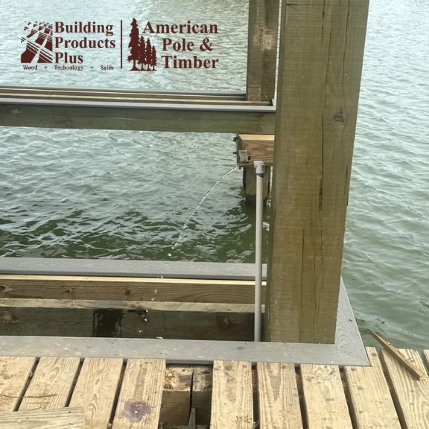
6. What if your existing pilings are still standing but showing wear?
Not every dock construction project is new construction. If you already have a dock with wood pilings showing checking, soft spots, or surface deterioration, but the structural core is still sound, you may not need full replacement yet.
SnapJacket piling repair is a jacketing system that wraps around an existing piling, fills the void with concrete, and extends the piling’s service life without pulling it out. It can be installed in the water by a dive crew or at low tide. For homeowners and marina operators looking at a partial rehab rather than a full rebuild, this option can save significant money and time.
If the pilings are too far gone for repair, full replacement with EcoPile®, XPile™, or treated wood pilings is the path forward. Your contractor should be able to assess existing piling condition and recommend repair vs. replacement. Building Products Plus supplies both SnapJacket repair systems and full replacement pilings from our Houston yard.
7. How do you choose the right contractor for dock construction Gulf Coast projects?
A good marine contractor is worth every dollar, and a bad one will cost you more than you save.
They should know the local permitting process. In Texas, that means GLO submerged land leases and Corps of Engineers permits. In Louisiana, it means Coastal Use Permits and parish-level requirements. If they are fumbling through these questions, they have not done many dock construction Gulf Coast projects in your area.
They should have opinions about piling materials, not just use whatever is cheapest. They should be able to explain why they are recommending a specific piling type, treatment level, and hardware spec for your site.
Ask for references from dock construction projects in saltwater, not just freshwater lake docks. Gulf Coast saltwater construction is a different skill set. Ask to see photos of finished projects, and ask how those projects held up through a storm season.
If you do not have a contractor yet and you need help figuring out what materials to specify, contact our team at (713) 434-8008. We work with homeowners, contractors, and engineers on Gulf Coast dock construction projects every week from our Houston yard.
Frequently asked questions
How much does dock construction cost on the Gulf Coast?
It depends on size, piling material, decking, and site conditions. A simple residential dock on treated pilings might run $150 to $250 per linear foot installed. Larger commercial docks on premium pilings cost more. Get a detailed materials-and-labor breakdown from your contractor.
How deep do pilings need to be for a Gulf Coast dock?
Embedment depth depends on soil conditions, load requirements, and local code. In soft Gulf Coast soils, pilings may need to be driven 15 to 25 feet below the mudline to reach adequate bearing capacity. Your engineer or contractor should determine this based on a soil survey or local experience.
What AWPA use category applies to Gulf Coast saltwater pilings?
UC5C is the highest marine exposure category. It covers the entire Gulf Coast from the Florida Keys to the Texas-Mexico border. CCA retention for Southern Yellow Pine pilings at UC5C is typically 2.5 pcf.
How long does it take to get a dock construction permit in Texas or Louisiana?
It varies. Some Texas coastal counties process permits in a few weeks. Projects requiring GLO or Corps of Engineers review can take 2 to 6 months. In Louisiana, Coastal Use Permits typically take 30 to 90 days depending on the parish.
Does the 2026 hurricane forecast mean I can skip storm engineering?
No. NOAA predicts below-normal activity, but Tropical Storm Arthur and Tropical Storm Bertha both hit the Gulf Coast this season. A below-normal forecast is not a guarantee. Design for storms from day one.
What is the best piling material for residential dock construction on the Gulf Coast?
There is no single best. It depends on your budget, lifespan expectations, and maintenance tolerance. Treated wood is the most affordable upfront. EcoPile® gives you 25 years maintenance-free. XPile™ is built for 50 years. Gun Barrel Pilings® add uniform appearance to structural strength.
Does Building Products Plus deliver to job sites in Louisiana?
Yes. We deliver across Texas and Louisiana from our Houston yard at 12317 Almeda Rd. Call (713) 434-8008 for delivery timing and availability on pilings, treated lumber, and marine materials.
Conclusion
Dock construction Gulf Coast is not complicated, but it rewards people who plan. The homeowners and contractors who take time to sort out permits, pick the right piling material, plan for storms, and set a realistic budget end up with structures that last decades.
Building Products Plus supplies extended-life marine construction materials from our Houston yard to job sites across Texas and Louisiana. Pilings, treated lumber, Sure-Step decking, SnapJacket repair systems, and everything you need for docks, marinas, bulkheads, and shoreline structures.
Call (713) 434-8008 or visit BuildingProductsPlus.com/contact to discuss your dock construction project.
Sources
- NOAA 2026 Atlantic Hurricane Season Outlook, updated August 6, 2026
- AWPA Book of Standards, Use Category System
- FEMA Flood Zone Designations and Coastal Construction Requirements
- Texas General Land Office, Submerged Lands Program
- Louisiana Office of Coastal Management, Coastal Use Permits