Gulf Coast piling requirements 2026: 5 code changes that save you from costly rework

Gulf Coast piling requirements are getting stricter in 2026, and Gun Barrel Pilings® are the structural piling solution built to meet them. Uniform diameter, no taper, and available lengths up to 52 feet make them the right choice for projects that must comply with updated TDI windstorm codes, higher elevation standards, and tighter foundation engineering specifications.
Two major code updates are converging on the Gulf Coast this year. In Texas, the Department of Insurance adopted the 2024 IRC and IBC for windstorm construction, with compliance required for all projects starting after April 1, 2026. In Florida, the 9th Edition Building Code takes effect December 31, 2026, expanding the 160 mph wind zone to all construction within 5 miles of tidal water. For contractors working the Texas and Louisiana coast, the foundation is where these changes hit first.
Key takeaways
- TDI adopted the 2024 IRC and IBC for windstorm construction. Projects started after April 1, 2026 must comply to maintain TWIA insurance eligibility.
- Florida’s 9th Edition Building Code expands the 160 mph design wind zone. It covers all new construction within 5 miles of tidal water statewide, effective December 31, 2026.
- Higher freeboard is driving up foundation costs. Houston and several Gulf Coast municipalities now require finished floor elevations 2 to 3 feet above base flood elevation.
- Gun Barrel Pilings® are the only uniform-diameter piling produced at scale in the U.S. The equipment and supply chain to manufacture them don’t exist anywhere else.
- Building Products Plus supplies complete foundation packages across Texas and Louisiana. Marine pilings, treated lumber, and hardware ship from our Houston yard.
What are the new Gulf Coast piling requirements for 2026?
Gulf Coast piling requirements are tightening on two fronts simultaneously. Texas has adopted stricter windstorm construction standards through the Texas Department of Insurance, and Florida is rolling out a new edition of the state building code that raises wind resistance thresholds across coastal zones.
For Texas and Louisiana contractors, the TDI update has the most immediate impact. It’s already in effect. The Florida code change matters for companies that take projects across state lines, and because Florida’s standards tend to influence Gulf Coast engineering practices even outside Florida’s borders.
How does the TDI windstorm code update affect Texas coastal projects?
The Texas Department of Insurance adopted the 2024 International Residential Code and 2024 International Building Code as the basis for windstorm construction standards in designated coastal areas. The effective date was April 1, 2026.
Any project that started construction after that date must demonstrate compliance to receive windstorm certification. Without it, the structure isn’t eligible for coverage through the Texas Windstorm Insurance Association (TWIA). For coastal Texas, TWIA eligibility isn’t optional. It affects the project’s insurability, financing, and resale value.
The updated codes incorporate advances in structural wind resistance, roof and wall attachment systems, and foundation design. For piling-supported structures, the connection between piling and superstructure must meet tighter fastening schedules, and the pilings themselves must handle updated wind load calculations.
Texas doesn’t adopt building codes statewide the way Florida does. Each jurisdiction decides what to adopt and when. But TDI windstorm requirements apply across all designated coastal areas regardless, making them the de facto standard for any insurable project from Beaumont to Brownsville.
What elevation and freeboard standards apply to Gulf Coast foundations?
In Houston and several other Gulf Coast jurisdictions, residential projects must now set the finished floor elevation 2 to 3 feet above the base flood elevation (BFE). That freeboard requirement has increased foundation costs by an estimated 10 to 15 percent on new construction.
Updated FEMA flood insurance rate maps are reclassifying properties into higher-risk zones, triggering stricter elevation requirements even in areas that weren’t previously subject to them.
For piling foundations, higher elevation means longer pilings. A structure that previously needed 30-foot pilings may now require 35 or 40-foot pilings to achieve the same structural support at a higher elevation. Meeting these updated requirements changes the material spec, the freight cost, and the installation plan.
Why does your piling choice carry more weight under the 2026 codes?
When codes demand more from the foundation, every piling decision matters more. The type of piling you specify affects engineering calculations, installation time, inspection outcomes, and long-term structural performance.
A traditional tapered piling changes diameter from butt to tip. Your engineer has to factor that taper into every load calculation, and the crew has to deal with pilings that don’t line up cleanly during installation. Inconsistent pilings mean more field adjustments, which means more time and more risk of an error that gets flagged during a stricter 2026 inspection.
Square timbers create a different problem. Each one has to be squared to each connecting member. On a Gulf Coast beach home where pilings weigh 500 to 1,000 pounds, that’s significant labor. And square timbers expose heartwood on the cut faces, which gives marine borers a point of entry in saltwater environments.
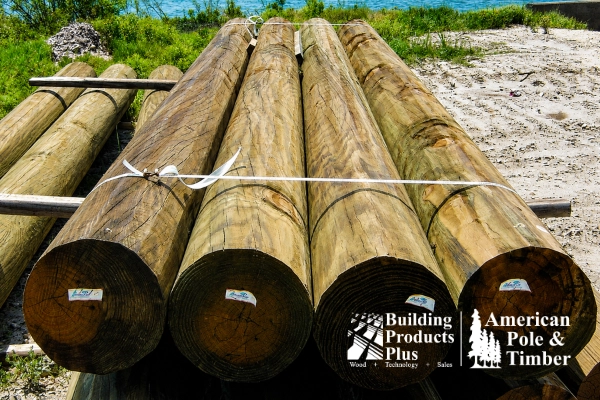
How do Gun Barrel Pilings® meet the Gulf Coast piling requirements?
Gun Barrel Pilings® are precision-milled to eliminate natural taper. Every piling has a true uniform diameter from top to bottom, verified at the mill before it ships. That uniformity directly addresses the engineering and installation challenges that the 2026 codes amplify:
| 2026 code requirement | Traditional pilings | Gun Barrel Pilings® |
|---|---|---|
| Uniform section for load calculations | No. Taper requires per-piling engineering adjustments. | Yes. Consistent diameter simplifies structural design. |
| Lengths for higher elevation | Limited by natural taper at longer lengths. | Available up to 52 feet long, 20 inches in diameter. |
| TDI wind load connections | Varying diameter complicates bracket and strap sizing. | Uniform diameter allows consistent connection hardware. |
| Marine borer resistance | Square timbers expose heartwood on cut faces. | No exposed heartwood. Round profile resists borers. |
| Storm surge flow | Square shapes create turbulence and low-pressure zones. | Round shape lets water pass with less drag and uplift. |
Gun Barrel Pilings® can be pressure treated to any AWPA Use Category specification, including UC5B and UC5C for saltwater marine environments. They meet the same structural grading standards as traditional round and square pilings and can be specified for any coastal application from Galveston to Lake Charles.
For projects that need additional protection at the waterline, polymer coated wood adds decades of service life by creating a barrier against shipworms, barnacles, and fungus in the splash zone where damage concentrates.
Where are Gun Barrel Pilings® being used on the Gulf Coast?
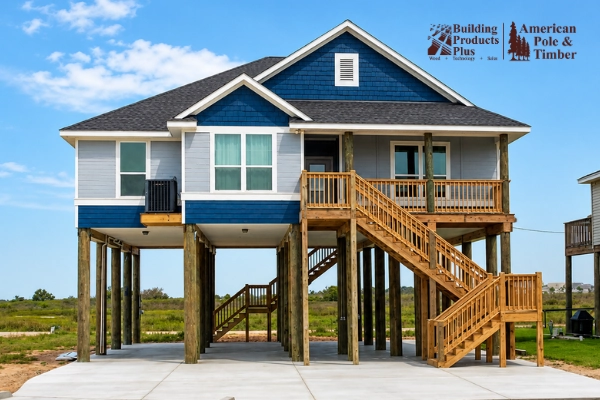
SL Walker Builders has specified Gun Barrel Pilings® exclusively for every elevated beach home they’ve built in Terramar Beach, Galveston. These homes sit directly on the Gulf, the pilings are visible from the street, and the project required a piling that could handle saltwater exposure while delivering a clean, consistent appearance.
Shannon Walker selected Gun Barrel Pilings® because they match the structural requirements of a marine environment while providing the uniform aesthetic that sets his builds apart from the competition. The partnership continues, with plans for several hundred additional homes along the Texas coast.
Building Products Plus supplies Gun Barrel Pilings® and marine-grade treated lumber to contractors throughout the Texas and Louisiana Gulf Coast from our Houston yard at 12317 Almeda Rd. We’ve been doing it since 1993.
How can you protect your foundation investment?
When you bundle pilings, stringers, and hardware through our Foundation Package, every component is covered by a single 25-year warranty. That warranty covers the entire foundation assembly, not just individual parts.
On a project where the 2026 Gulf Coast piling requirements, local freeboard rules, and TWIA certification all demand a higher-performing foundation, having one warranty across the entire package reduces risk for the contractor and gives the property owner confidence in the investment.
Our foundation piling options for elevated structures include:
- Gun Barrel Pilings® (uniform diameter, no taper, up to 52 ft, up to 20 in. diameter)
- CCA-treated Southern Yellow Pine pilings (marine grade, AWPA UC5B/UC5C)
- Custom lengths and diameters milled to your project specifications
- Complete material packages with stringers, hardware, and delivery coordination
Frequently asked questions about Gulf Coast piling requirements
What changed in the Texas windstorm building code for 2026?
The Texas Department of Insurance adopted the 2024 IRC and 2024 IBC as the windstorm construction standard for designated coastal areas. Projects starting after April 1, 2026 must comply with these updated codes to receive windstorm certification and remain eligible for TWIA insurance coverage.
Do I need TWIA certification for my coastal Texas project?
If the structure is in a TDI-designated windstorm area and needs windstorm insurance through the Texas Windstorm Insurance Association, yes. Without TDI windstorm certification, the property may not qualify for coverage, which can affect financing and resale.
What are the current freeboard requirements for Gulf Coast foundations?
Requirements vary by jurisdiction. Houston and several Gulf Coast cities require finished floor elevations 2 to 3 feet above base flood elevation. Check with your local building authority or FEMA flood map data for the specific BFE and freeboard requirements at your project site.
What makes Gun Barrel Pilings® different from standard round pilings?
Gun Barrel Pilings® are precision-milled to a true uniform diameter with no taper. Standard round pilings change diameter from butt to tip, which complicates engineering and installation. Gun Barrel Pilings® are available up to 52 feet long and 20 inches in diameter.
Can Gun Barrel Pilings® be treated for saltwater marine use?
Yes. Gun Barrel Pilings® can be pressure treated to any AWPA Use Category specification, including UC5B and UC5C for full saltwater marine exposure. Treatment levels are matched to the project requirements.
How do I get a quote for foundation pilings from Building Products Plus?
Call Building Products Plus at (713) 434-8008 or contact us online. Provide your project location, piling lengths, diameters, and treatment requirements. One of our project consultants will prepare your quote.
Ready to spec your next Gulf Coast foundation?
If you’re working on a coastal project in Texas or Louisiana, the 2026 Gulf Coast piling requirements are already in play. Talk to Building Products Plus about piling specifications, treatment levels, lead times, and delivery to your job site.
Call (713) 434-8008 or visit BuildingProductsPlus.com.
We’re at 12317 Almeda Rd in Houston. If we don’t have it, we’ll make it.